Travel beyond the trail
Using snowshoes grants us freedom to explore wintery forests, snow-covered mountains and ice free streams.
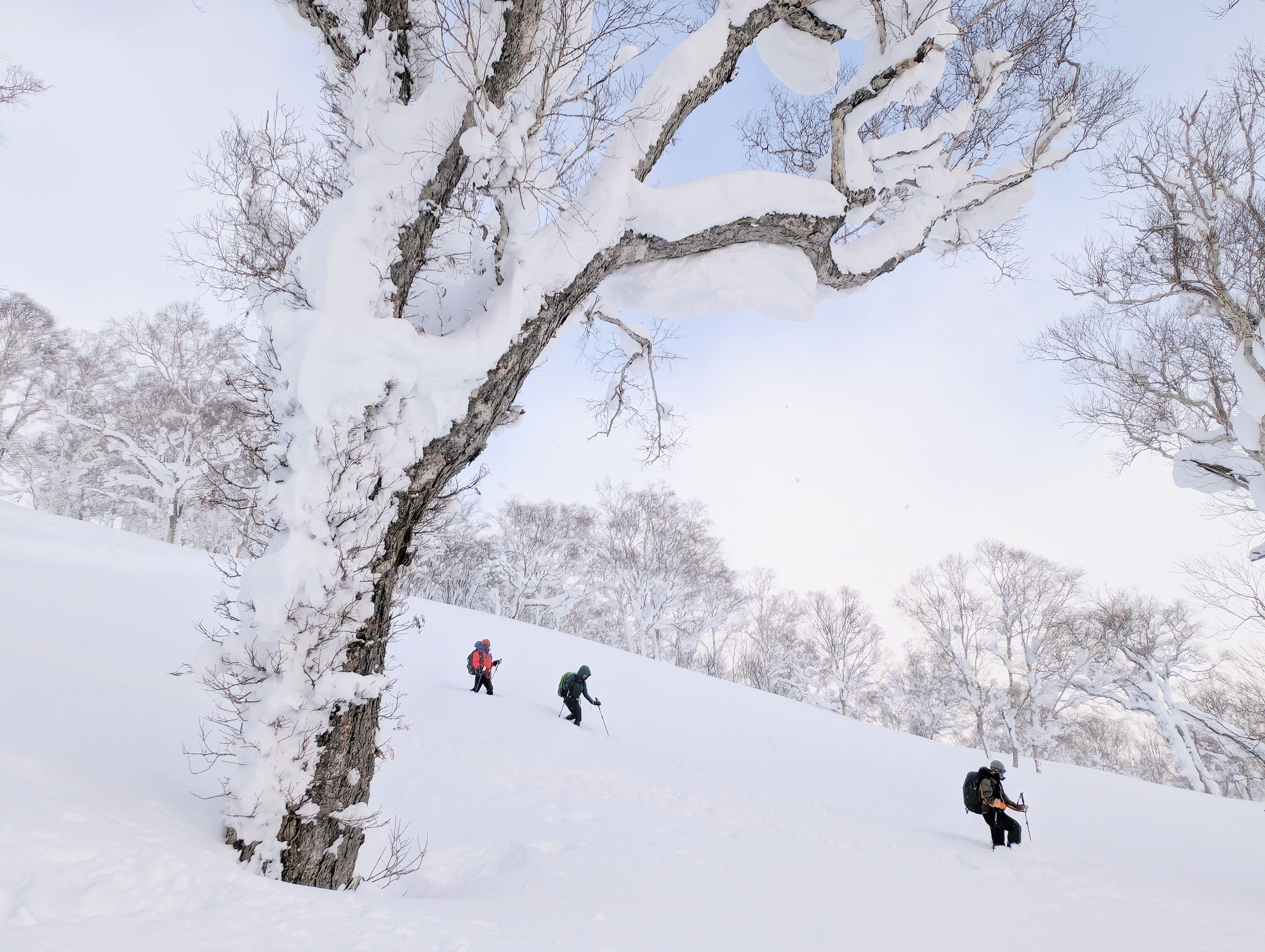
Explore a land of ice and fire among the snow-capped volcanoes of Shikotsu-Toya National Park. Experience firsthand the fluffy snow, winter forests, white peaks, and frozen waterfalls of Sapporo’s closest national park.
Shikotsu–Toya National Park lies close to Sapporo and is home to a number of spectacular caldera lakes and steaming active volcanoes. The volcanoes concentrated in the region have of course given rise to several natural hot springs, meaning that it is popular among domestic Japanese visitors for its many resorts. For us, however, it is not the resorts that we are interested in but the amazing landscape that makes this national park perfect for adventure travel.
As well as the warm hot springs, it is also home to rich forests, fascinating geological hikes and incredible wildlife. In winter, mountain trails open up as snowshoeing routes that allow the adventurous to experience the unique sight of fiery volcanoes capped with Hokkaido’s magical snow and pure blue caldera lakes surrounded by white mountain rings.
Using snowshoes grants us freedom to explore wintery forests, snow-covered mountains and ice free streams.
Explore active volcanic landscapes, seeing the power of our Earth in steaming fumaroles and bubbling boiling springs.
Japan’s northern most ice-free lake is a stunning sight when surrounded by snow capped peaks.
In the volcanic circle of Shikotsu-Toya National Park, there's no shortage of hot springs to warm us up after our time out in the cold.
Including Red Squirrel, Japanese Deer, Japanese Red Fox and migratory Whooper Swans.
We meet in Chitose after lunch then head straight to Lake Utonai for our first winter adventure. This flat lakeshore loop provides the perfect opportunity to get accustomed to walking on snow and test out our gear in a serene wetland setting. While we walk, we keep a lookout for migratory birds like Whooper Swans that frequently rest on the water.
Later, we transfer to the deep caldera of Lake Shikotsu within the Shikotsu-Toya National Park. Our stay at a lakeside ryokan (Japanese Inn) offers the chance to soak in an onsen (hot spring) with views of the lake. We conclude our first day with a traditional dinner at our ryokan.
We head for the mountains to tackle our first peak of the tour, Mt. Monbetsu (865m). This climb offers a steady introduction to Hokkaido’s winter peaks, following a wide mountain road favoured by local snowshoers. As we gain elevation, the trail provides spectacular vantage points over Lake Shikotsu and the neighbouring summits of Mt. Fuppushi and Mt. Tarumae. On a clear day, you can see as far as the smoking vents of the active volcano, Mt. Eniwa.
Because the upper slopes are exposed to Hokkaido's unpredictable winter weather, we remain flexible; if conditions are unsuitable for the summit, we will explore sheltered forest trails at lower altitudes instead. Depending on the day's conditions, we will either enjoy a picnic lunch on the mountain or head into Lake Shikotsu town for a local meal after our descent.
Later, we move to our next base in Kitayuzawa. This riverside hotel features expansive outdoor baths, allowing you to soak in the crisp air and soothe your legs in the healing hot spring waters.
Winter in Hokkaido transforms the landscape, burying dense undergrowth and giving us the freedom to travel beyond the usual trails. Today our guides choose the best route depending on the weather and the season. We either explore a secluded valley on a 7.4km hike, following streams through the forest to reach dramatic waterfalls frozen into towering ice columns, or we head to Orofure Pass for a 5.3km ridgeline walk with wide views across Shikotsu–Toya National Park from Mt. Bakemono (1070m).
We enjoy lunch either out on the snow or at a local café, depending on the weather. After our hike, we return to our riverside accommodation in Kitayuzawa for a warming meal and another restorative soak in the hot springs.
We head to the rim of the Lake Toya caldera to climb the active stratovolcano, Mt. Usu. Our route takes us through snow-covered old-growth forests as we ascend toward the crater rim. Upon reaching the top, we are met with a dramatic contrast: the vast Pacific Ocean on one side and the steaming, rugged caldera of Mt. Usu on the other. We continue to the crater observatory for a bird’s-eye view of this volatile volcanic landscape before beginning our descent.
Because the crater rim is highly exposed to the elements, we may swap the order of our activities and do this on day 3 instead. This flexibility ensures we have the best possible weather for the volcano, while still experiencing both adventures.
After the hike, we travel to the hot spring village of Jozankei Onsen, where we stay for the next two nights. We end the day with a traditional dinner and a soak in the local thermal waters.
Mt. Kokimobetsu is a popular choice for local hikers due to the exceptionally light, dry powder snow that blankets its slopes. Lined with hardy Erman’s Birch trees, the mountain offers quintessential Hokkaido scenery and a genuine taste of the region's winter backcountry.
The trail begins with a steep climb before flattening out onto a forested ridge where magnolia trees grow amongst the winter canopy. As we push toward the summit at 970m, the trees thin to reveal incredible views of Mt. Yotei. Known as Ezo-Fuji for its near-perfect conical shape, it is one of the most iconic sights in the region.
Because the mountain is at the mercy of the weather, we remain flexible; if conditions are unsuitable for the summit, we will instead explore the powder-filled forests and streams at its base. On our return journey, we stop at the Nakayama Pass Roadside Station to warm up with hot drinks and browse local specialities. We spend our final night back at Jozankei Onsen, gathering for a celebratory dinner to mark the completion of our journey.
Otsukaresama desu! (Good job!) Our tour finishes after breakfast today, leaving you plenty of time for onward travel.
Have a safe onward journey! Itterasshai!
This tour covers a broad spectrum of winter terrain, from slopes where the snow can be knee-deep to packed snow trails and buried roads. On one day, we also navigate several shallow creek crossings. We use snowshoes when necessary to walk on top of the snow and explore wilderness areas beyond the summer trails. On well-trodden or wind-blown paths, we may instead hike in standard winter boots.
Snowshoeing is accessible to all and straightforward to learn, you can read our introduction to snowshoeing for an outline of what to expect. We will hike up to 8.7km in a day. We have balanced some days with a lot of elevation gain – up to 570m – with flatter days in the forest. Snowshoeing is physically more demanding than standard hiking, so take this into account when reviewing the distances and elevation profiles. If you are a reasonably fit walker who is happy spending the whole day on the trail, you will be able to complete these hikes comfortably.
Expect average temperatures between 0°C and -10°C, though colder extremes are possible. While the air is frigid, the physical effort of snowshoeing or hiking warms you up quickly. If you dress only for the cold, you will overheat and perspire while moving; this moisture leads to a rapid chill once you stop. A versatile layering system is essential to stay dry and warm. Please consult the packing list to ensure you have the correct clothing for these conditions.
“Outstanding. Exemplary.”
Outstanding. Exceptionally well managed from an exemplary outfitter.
This tour consists of a series of snow hikes from different trailheads around the region. Each hike takes about 4 hours – enough time to enjoy Hokkaido’s brisk winter without being in the cold for too long. We travel between locations in our van, where your luggage remains during the day. This allows you to explore with only a light day pack. After each hike, we transfer to our accommodation, which all feature onsen (hot springs) so you can rewarm and recover after a day in sub-zero temperatures.
Your guides are with the group throughout. Having a guide lead the way means you can relax and take in the scenery. They are also there to provide context on the local landscape and help navigate the dishes served in the evenings.